


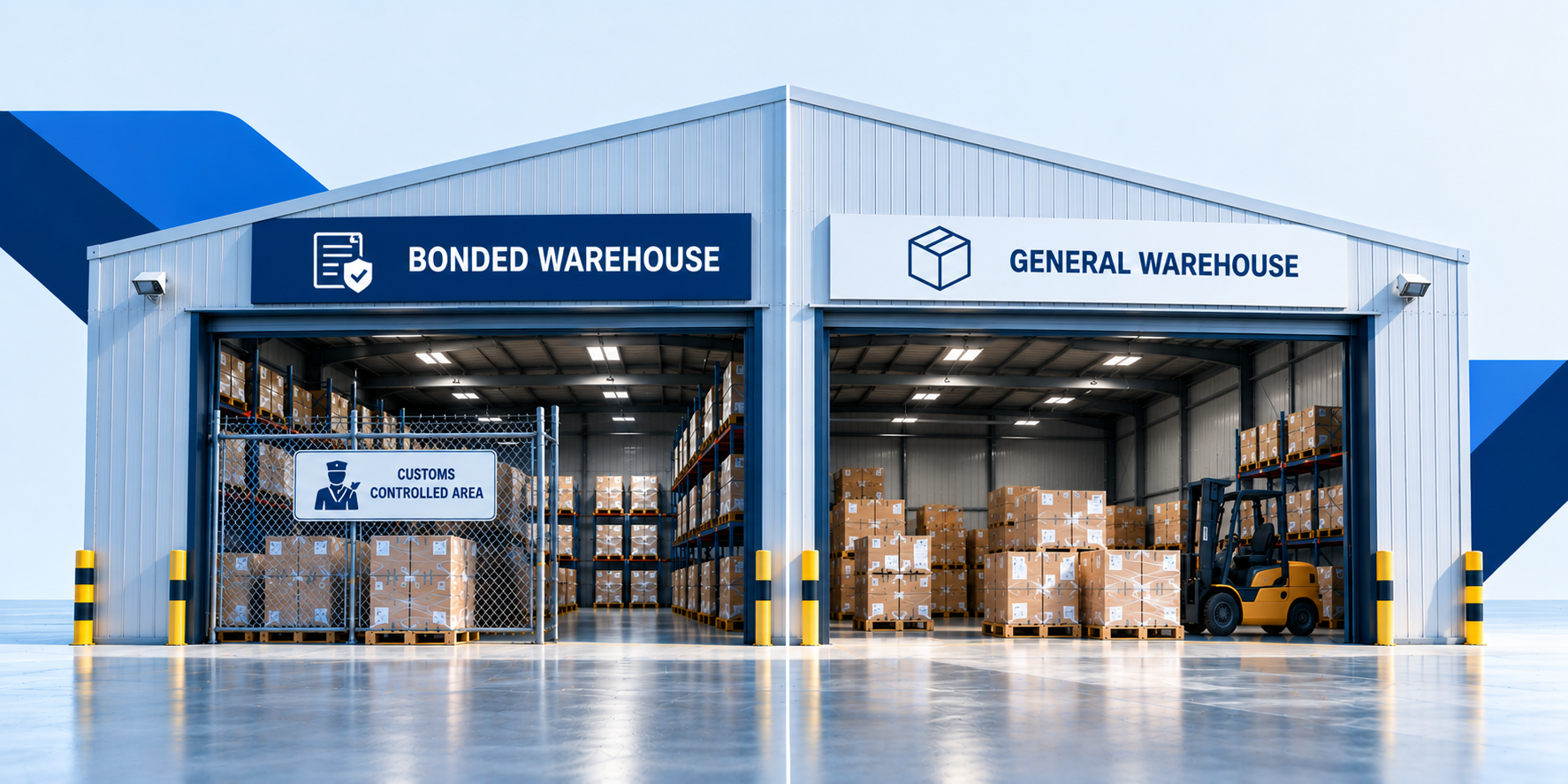
Quick answer: A bonded warehouse (called almacén fiscal in Costa Rica) stores foreign goods that have not yet cleared customs, under customs control. Duties and taxes are paid only when goods are released into the local market, and goods re-exported from the warehouse pay no Costa Rican import taxes. A general warehouse (called bodega general in Costa Rica, and a conventional warehouse elsewhere) stores goods that have already cleared customs, with taxes paid, ready for distribution with no further paperwork.
- Choose a bonded warehouse if you sell gradually, re-export part of the shipment or carry high-value inventory.
- Choose a general warehouse if everything will be sold in Costa Rica and you need to ship daily.
An imported shipment can be physically ready to enter a warehouse and still not be ready to clear customs. That gap determines when you pay taxes, when you can sell the goods and how much capital sits tied up in inventory.
For an importer in Costa Rica, a distributor serving several countries in the region, or a company buying through Miami, this decision belongs in purchase planning, not after the container has already reached Moín or Caldera.
Key takeaways
- A bonded warehouse does not eliminate taxes; it defers them until goods are released for local consumption.
- Goods re-exported from a bonded warehouse pay no Costa Rican import taxes.
- A general warehouse offers more speed for daily dispatch, e-commerce and retail.
- A hybrid model (strategic inventory in bonded storage, daily operations in a general warehouse) is often the most efficient setup for regional distributors.
- No warehouse can fix a poorly prepared import: tariff classification, declared value and documents must be right from origin.
Side-by-side comparison
| Criteria | Bonded warehouse (almacén fiscal) | General warehouse (bodega general) |
|---|---|---|
| Status of goods | Foreign, not cleared | Cleared through customs |
| Payment of duties and taxes (DAI, VAT, etc.) | When withdrawn for local sale | Before entering the warehouse |
| Customs control | Yes, every movement is traceable | No customs regime applies |
| Re-export | Yes, without paying local taxes | Possible, but taxes were already paid |
| Partial withdrawals | Yes, clearing lot by lot | Unrestricted, no customs filing |
| Dispatch speed | Slower: each release needs a filing | Faster: immediate dispatch |
| Product handling | Limited to what the regime allows | Unrestricted (labeling, kitting, picking) |
| Best for | High value, gradual sales, multiple markets | High turnover, defined local market |
What is a bonded warehouse?
A bonded warehouse, known in Costa Rica as an almacén fiscal, bodega fiscal or depósito fiscal, is a facility authorized by Costa Rica’s National Customs Service to hold foreign goods that have not yet been cleared. It operates under the General Customs Law (Ley General de Aduanas) and its regulations. Every receipt, release, adjustment and internal movement is recorded and subject to control.
It is not an ordinary warehouse with a different label: documentary and physical controls determine what can be done with the goods, and when.
Benefit 1: defer taxes and protect cash flow
The most visible benefit is financial. Instead of paying taxes on the entire shipment on arrival, the company clears only what each order requires and pays taxes on that release.
Illustrative example: a company imports a container of spare parts with a CIF value of USD 200,000. Assume a 9% import duty (DAI) plus Costa Rica’s 13% VAT:
| Scenario | Taxes on arrival | Taxes in month 1 | Taxes in months 2–4 |
|---|---|---|---|
| Clear everything on arrival | ~USD 45,700 | — | — |
| Bonded warehouse, release 25% per month | — | ~USD 11,400 | ~USD 11,400 per month |
Simplified calculation to illustrate the cash-flow effect. Actual taxes depend on tariff classification, product and other applicable charges.
With a bonded warehouse, about USD 34,000 stays available in the first month. The benefit depends on turnover, though: if you will clear everything right away, deferral adds little and may not cover the operating cost of the regime.
Benefit 2: re-export or redirect cargo
For a regional distributor, a bonded warehouse works as a distribution hub. It can receive consolidated cargo, hold it under customs control and later ship it to Panama, Nicaragua, Guatemala or the Dominican Republic, clearing only the portion sold in Costa Rica.
This also suits seasonal goods, product launches and inventory with uncertain demand, where deciding later has real value.
Limits to plan for
- Storage time limits: goods cannot stay indefinitely. Confirm with your customs broker the limit that applies to your regime.
- Restricted handling: labeling, repackaging or order preparation may require authorization.
- Inspections and shortages: agree in advance how damage, inventory discrepancies and returns will be handled.
- Accurate documentation: mismatches between the invoice, packing list, customs declaration (DUA), classification and physical quantities cause delays and liabilities.
What is a general warehouse?
In Costa Rica, a bodega general is what other countries call a general or conventional warehouse: a facility that holds goods that have already cleared customs, with taxes paid. Its main advantage is speed: it lets you pick orders, restock stores, fulfill e-commerce and deliver to B2B customers without a customs filing for every release.
It is the simplest option for high-turnover inventory with a defined local market. That does not mean less control: a good general warehouse still needs inventory management, security, picking, dispatch and, depending on the product, handling for refrigerated, heavy or high-value cargo.
How to decide: four criteria
1. Destination of the goods
- Will everything be sold in Costa Rica in the coming days? → General warehouse.
- Will part be re-exported, or is the final buyer not yet confirmed? → Bonded warehouse.
2. Cash flow
- High-value inventory, long sales cycles or recurring imports? → Bonded warehouse.
- Small or urgent shipments, or products that sell out quickly? → General warehouse.
3. Type of product
- Industrial equipment, spare parts, capital goods, seasonal or multi-destination goods → Bonded warehouse.
- Consumer goods, active promotions or daily replenishment → General warehouse.
4. Operational complexity
Every transfer between facilities, partial release or document correction has a cost and a lead time. Consolidating international freight, customs brokerage and warehousing with one coordinator reduces handoffs.
Three real-world scenarios
Regional spare-parts distributor. Imports machinery parts and serves customers in Costa Rica, Panama and the Dominican Republic. Bonded warehouse: clears only what sells in Costa Rica and re-exports the rest without paying local taxes on it.
Local retailer and e-commerce. Imports products already committed to stores and online campaigns. General warehouse: cleared goods are ready to ship orders every day.
Hybrid model. Keeps strategic or uncertain-demand inventory in bonded storage and moves what feeds daily operations to a general warehouse. This requires precise visibility to avoid stockouts, double handling and gaps between physical and documented inventory.
Bonus, from Miami: some companies hold inventory in a bonded warehouse in Miami and send to Costa Rica only what already has a buyer. This defers both the Costa Rican import taxes and part of the freight cost. It is worth evaluating for companies that buy from several U.S. suppliers.
Costs you should not leave out
The import duty is not the only number. Compare:
- Storage rates and extended-stay charges
- Handling, internal movements and order preparation
- Insurance and local transportation
- Document management and filings for each release
- Financial cost of capital tied up in taxes paid upfront
- Cost of time: if sales promises immediate delivery, confirm the bonded operation can deliver on it
Pay special attention to tariff classification. An incorrect classification changes the tax calculation and can lead to adjustments, audits or penalties. The same goes for declared value and origin.
Design the flow before the shipment leaves
Before confirming your next international purchase, answer these questions:
- What share will be sold in Costa Rica, and how much could go to another market?
- What volume will be cleared at the start?
- What is the expected turnover?
- What permits, inspections or technical approvals does the product need?
- Who authorizes each release from the warehouse?
With those answers, your logistics provider can plan freight, customs clearance and storage around the reality of the shipment.
How SICSA helps
SICSA has supported importers in Costa Rica since 1976 with customs brokerage, international freight forwarding and warehousing coordination. Together with our sister operation in Miami, Logistics SICSA LLC, we manage the full flow as a single operation:
- Origin: consolidation and bonded warehousing in Miami.
- Transit: air or ocean freight to Costa Rica.
- Destination: full or partial customs clearance, storage and distribution.
That way, the choice between a bonded and a general warehouse is based on your route, your inventory and your cargo’s final destination, not on habit.
Frequently asked questions
What is a “bodega general” in Costa Rica?
It is the Costa Rican term for a general or conventional warehouse: a facility that stores goods already cleared through customs, with taxes paid, ready to be sold and distributed in the local market.
What is the difference between a bonded warehouse and a general warehouse?
A bonded warehouse holds foreign goods that have not cleared customs, under customs control, with taxes deferred. A general warehouse holds goods that have already cleared customs, with taxes paid and ready for distribution.
Are taxes waived in a bonded warehouse?
No. They are paid when goods are released for local consumption. Goods re-exported from the warehouse pay no Costa Rican import taxes.
Can I withdraw goods from a bonded warehouse in partial lots?
Yes. You can clear partial releases and pay taxes only on each release, following the applicable customs procedure.
How long can goods stay in a bonded warehouse in Costa Rica?
There is a maximum storage period set by customs regulations and the regime used. Confirm it with your customs broker before shipping so the goods are not declared abandoned.
Is a bonded warehouse worth it for small shipments?
Usually not. For small or immediate-sale shipments, the operating and administrative costs of the bonded regime tend to outweigh the benefit of deferring taxes.
Can I combine a bonded warehouse and a general warehouse?
Yes. A hybrid model keeps strategic or uncertain-demand inventory in bonded storage and daily-operation stock in a general warehouse. It requires good inventory visibility.
Planning your next import into Costa Rica? Talk to the SICSA team and design the storage flow that best protects your cash and your delivery times.
This article is for general information and does not replace advice from a licensed customs broker for your specific case. Time limits, taxes and procedures depend on current regulations and the regime applied.