


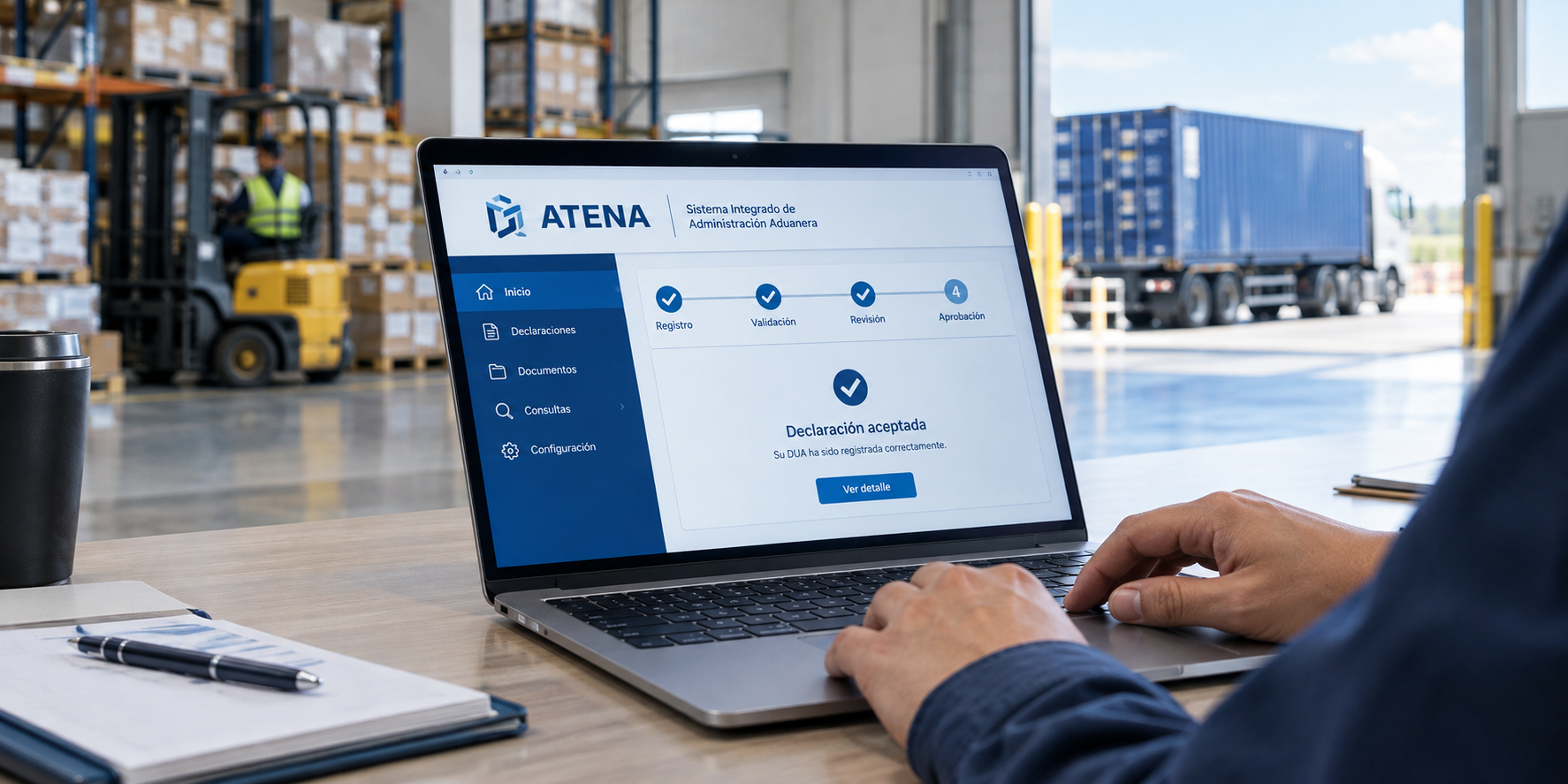
ATENA is Costa Rica’s new customs management system, built by the Ministry of Finance (Hacienda) to replace TICA, the platform used today to file every customs declaration. It goes live in Q1 2027, starting with exports, and will roll out in phases. For your business, that means cleaner data, mandatory digital signatures and a well-prepared customs broker.
Whether you bring in spare parts, raw materials or retail inventory, this one affects you. It’s not a cosmetic software update. It changes how the country reviews, clears and audits every cross-border shipment for years to come.
What Is ATENA, and Why Is It Replacing TICA?
A quick glossary first:
- TICA (Customs Control Information Technology): the system Costa Rica’s DGA (General Directorate of Customs) has used for years to receive and process declarations.
- DUA (Single Customs Declaration): the official filing for every import or export. It states what you’re shipping, its value, its origin and the duties owed.
- ATENA: the new Integrated Customs Administration System, part of the Hacienda Digital modernization program.
As reported by Diario Extra in October 2026, ATENA is meant to replace and modernize the current tools for processing foreign trade operations, integrating import and export data with the rest of Hacienda Digital, including Tribu-CR, the tax platform that already replaced the old ATV portal.
Put simply: customs, tax and other Finance Ministry systems will finally talk to each other. What you declare at the border will be much easier to cross-check against what you report for taxes.
When Does ATENA Go Live?
The timeline shifted in 2026. According to Vice Minister of Finance Víctor Carvajal, the pilot programs announced in 2025 were dropped in favor of a phased rollout straight into production: the first release, planned for Q1 2027, covers exports, followed by four production releases in total, two per year.
The earlier plan, announced in July 2025, called for a pilot at Puerto Caldera before expanding to Moín, Paso Canoas and the airports. That sequence is off the table.
What this means for you:
- Exporters: you’ll be among the first ATENA users, starting in 2027.
- Importers: TICA stays in place for a while, but your migration is coming in later phases. Getting ready now saves headaches later.
What Changes in Day-to-Day Customs Clearance?
Automatic validation before filing
Based on what Hacienda communicated in 2025 (as reported by Delfino), the system will automatically check the data and block declarations containing errors, and it will cross-check declaration data against supporting documents.
In practice: if your commercial invoice says 500 units and your declaration says 50, ATENA flags it before the filing goes through. Fewer rejections down the line, but zero room for “close enough.”
Mandatory digital signature
Hacienda also stated in 2025 that there will be three transmission options, that digital signatures will be mandatory, and that operators will go through a new pre-registration process. If your company doesn’t have a valid digital signature yet, now’s the time to sort it out.
More data cross-checking
With systems connected, mismatches between what you import, what you invoice and what you report for taxes become easier to spot. For well-organized companies, that’s a plus. For those who leave paperwork for later, it’s a real risk.
How Will ATENA Affect Costa Rican Importers? A Real-World Example
Picture Laura, purchasing manager at a small company in Heredia that imports LED lighting from China by ocean freight.
Today, if her supplier sends an invoice with vague descriptions (“lights, assorted”), her customs broker calls, asks for clarification and the filing goes out a bit late. Under ATENA, that same inconsistency could stop the declaration at the starting line.
That’s why three details become critical:
- HS code (tariff classification): the number that classifies your product in the tariff schedule and drives what you pay.
- DAI (Import Tariff Duty): Costa Rica’s import duty, based on that classification.
- Accurate value and description: your invoice, packing list and bill of lading must match.
A wrong classification doesn’t just mean a duty adjustment. With automatic validation, it can also hold up your cargo and rack up storage or detention charges. To understand that cost, see our guide on what demurrage is and how shippers can avoid it.
The 2022 Lesson: Relying on a Single System
Many importers still remember the 2022 cyberattack. According to El Observador (2022), TICA and Exonet were offline for 67 days, and customs procedures that used to take hours stretched into days.
The takeaway was clear: when the system changes or fails, what makes the difference is a partner with solid processes and real experience. Grupo SICSA has been operating since 1976 and has lived through several transformations of Costa Rica’s customs system. The formula hasn’t changed: organized information and constant communication with the client.
How to Get Your Company Ready for ATENA: Step by Step
- Check your digital signature. Make sure whoever signs on behalf of your company has a valid one.
- Audit your HS codes. List your most frequent products and confirm their classification with your customs broker.
- Ask suppliers for better invoices. Clear descriptions, exact quantities, unit prices and the correct Incoterm (the international rule that sets who pays freight, insurance and bears risk, such as FOB or CIF).
- Organize your documents. Invoices, packing lists, permits and certificates of origin, digital and easy to find.
- Align customs with accounting. What goes on your declaration should match your tax records.
- Talk to your customs broker. Ask how they’re preparing for ATENA and what they’ll need from you. If you’re comparing options, this guide helps: how to choose the right customs broker in Costa Rica.
What Doesn’t Change with ATENA?
Good news: the underlying rules stay the same.
- Customs regimes (the legal category of your operation: definitive import, transit, bonded storage, export and so on) remain in place.
- The DUCA-T (Central American Single Transit Declaration), used to move goods across the region, is still governed by Central American rules. Learn more in our customs transit regime guide.
- Incoterms and how you negotiate them with suppliers don’t depend on the software.
What changes is the tool, the level of data accuracy required and how quickly errors get caught.
ATENA FAQs
Will ATENA replace TICA overnight?
No. The rollout is phased, with four production releases starting in 2027. During the transition, some operations will still run through TICA.
Which operations move to ATENA first?
Exports, according to the timeline Hacienda shared in October 2026. If you export, it’s worth reviewing your process now with our export logistics services team.
Will I need a digital signature to import under ATENA?
Hacienda announced in 2025 that digital signatures will be mandatory in the new system. Your customs broker can confirm which signatures apply to your case.
Will my import duties change with ATENA?
No. DAI and other taxes depend on your HS code and current law, not on the software. What does increase is scrutiny of correct classification.
How long will clearance take under ATENA?
There’s no official comparative data yet. SICSA can give you estimated lead times for your specific operation: [TIEMPO DE ENTREGA].
Ready to Import and Export Without Surprises?
ATENA is a chance to get your operation in order before the system forces you to. SICSA supports importers and exporters through our customs brokerage services, backed by Grupo SICSA’s experience since 1976.