


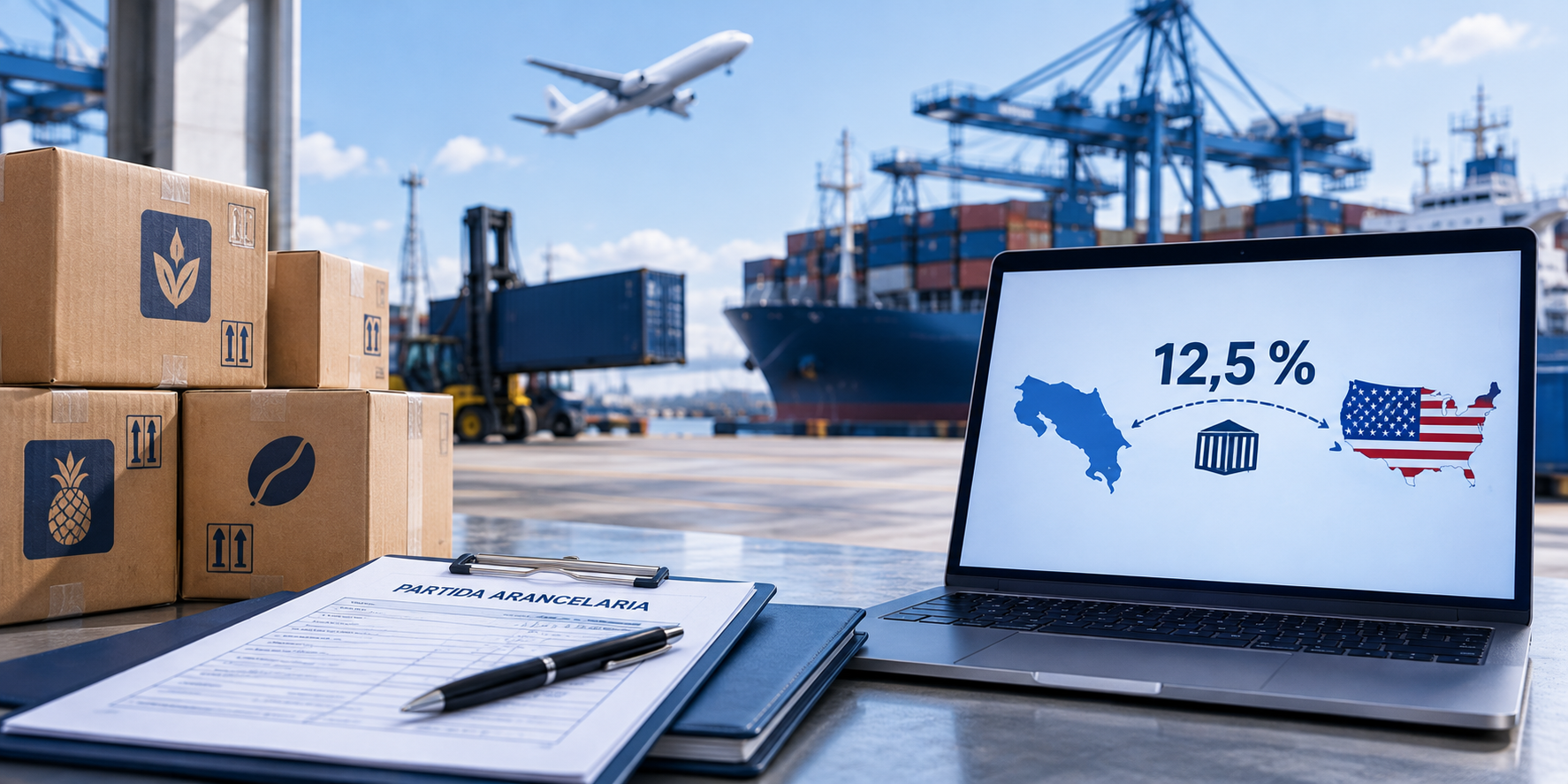
As of 12:01 a.m. Eastern Time on July 24, 2026, the United States applies a 12.5% tariff to certain products from Costa Rica. It replaces the earlier temporary 10% Section 122 surcharge; the two do not stack. The key for every exporter is to check their goods’ tariff classification.
What happened, and when?
Here is what official sources and the specialized press confirm:
- March 12, 2026: the USTR (the US trade representative’s office) opened Section 301 investigations into 60 economies, including Costa Rica.
- June 2, 2026: it named Costa Rica among economies that, in Washington’s view, had not banned or effectively enforced a ban on imports made with forced labor.
- July 23, 2026: Costa Rica’s trade ministry (COMEX) reported the USTR’s final determination.
- July 24, 2026: the 12.5% tariff took effect, replacing the temporary 10% Section 122 surcharge.
According to Crecex, as quoted by CRHoy, for covered products the real increase is 2.5 percentage points, not 22.5%, because the 12.5% does not pile on top of the earlier 10%.
Why does it matter for Costa Rica?
The US is the main destination for Costa Rican goods. According to PROCOMER, Costa Rica exported US$11.722 billion in goods in the first half of 2026 (+7%), and sales to the US reached US$5.283 billion, down 1% year on year. By our own calculation from those figures, that is roughly 45% of the total.
So any rule change in that market matters to the whole country: to companies that export directly, to those that supply an exporter, and to anyone who relies on a US customer.
Are all exports affected?
No. Some products are excluded, so don’t assume your goods will pay 12.5% before checking their tariff classification.
COMEX confirmed that existing exclusions remain for coffee, pineapple, bananas and orange juice, and that the exempt list now also covers cuttings, vegetable and fruit seeds, and certain refined sugars. CRHoy, citing Crecex, also reports category-level exclusions, including pharmaceuticals, data-processing equipment and semiconductors. That list is technical and can change, so always check the official source rather than relying on memory.
What is a tariff classification?
The tariff classification (HS code) is the number customs authorities use to identify each product and decide which duties and conditions apply to it. Two products that look alike can carry different codes, and that code decides whether your cargo falls inside or outside the tariff. You can find it on your previous export paperwork, or have your customs broker confirm it.
What could the cost impact look like?
A hypothetical example, only to illustrate the math (not real client data): if your US customer imports US$10,000 worth of goods and the product is covered, the tariff would be US$1,250. Under the earlier 10% surcharge it would have been US$1,000. Someone has to absorb that US$250 difference: you, your buyer, or both.
That is why you should be clear, before the next shipment, on who bears the tariff under your agreement with the customer and how it affects your margin.
What should you do before shipping?
- Confirm your product’s tariff classification.
- Check whether it is subject to the new tariff or falls under an exclusion.
- If it is affected, review the likely impact on your costs and selling prices.
- Talk to your buyer and your customs broker before confirming upcoming shipments.
Also keep your commercial invoices, product descriptions and technical sheets in order. When a product description is clear and complete, classification is easier to confirm and doubts along the operation shrink.
Before changing prices or making commercial decisions, check your goods’ classification and the applicable exclusions with your customs broker.
What is Costa Rica doing about it?
According to El Financiero, Trade Minister Indiana Trejos said the government will keep working in coordination with the productive sector and US authorities to improve access for Costa Rican products, and that it seeks to preserve the market-access conditions negotiated under CAFTA-DR.
Separately, Executive Decree 45941-H-MTSS-COMEX was published on September 29, 2026, ordering an official list of goods linked to forced-labor risks, per Delfino.cr. The same outlet notes the decree does not mention the US tariff or expressly tie itself to it. We will keep watching how it is applied.
FAQ
Does the 12.5% tariff apply to all Costa Rican exports to the US? No. It applies to certain products, and there are exclusions. Check your goods’ tariff classification.
When did it start? At 12:01 a.m. Eastern Time on July 24, 2026, according to COMEX.
Does it stack on the 10% surcharge? No. Per CRHoy, the 12.5% replaces the temporary Section 122 surcharge.
How do I know if my product is excluded? Compare your HS code with the official exclusions. A customs broker can help you confirm it.
Should I change my prices right away? Not before checking. First confirm whether your product is covered, and talk to your buyer about who bears the cost.
Need guidance?
SICSA has been in logistics and international trade in Costa Rica since 1976, 50 years, and was the 26th customs agency founded in the country (customs code CDA 026). We can guide you through reviewing your product and support you in planning your international trade operations. Our customs brokerage team advises on tariff items, procedures and permits, exonerations and free trade agreement review.
Explore our customs brokerage services, read how to choose a customs broker in Costa Rica, or write to comercial@sicsa.cr or call +506 2253-5400. You can also request a quote and talk to a SICSA executive.
Sources: COMEX press release CP-3250 (July 23, 2026); CRHoy (July 24, 2026); El Financiero CR (July 2026); PROCOMER, via El Financiero CR (July 28, 2026) and Punto EQ (August 6, 2026); Delfino.cr (September 29, 2026).